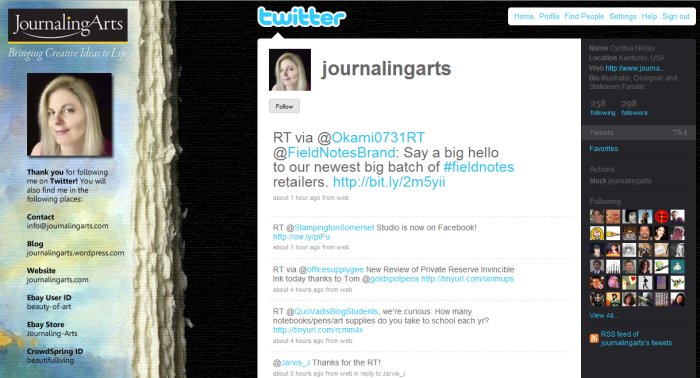
In meinem ersten Interview durfte ich Michaela von Aichberger alias @frauenfuss befragen. Dieses Mal ist eine weitere Dame an der Reihe, die Notizbuchfans bei Twitter unter ihrem Pseudonym @journalingarts kennen oder über Ihre Webseite journalingarts.com: Cynthia Niklas.
Das Interview hat sie mir natürlich in Englisch beantwortet, so dass ich zuerst mal die englische Fassung und in den nächsten Tagen auch die deutsche Fassung veröffentlichen werde.
The first interview with a notebook addict in this blog was an interview with Michaela von Aichberger alias @frauenfuss. The second interview is dedicated to a woman that is well known among the journaling art community with her Twitter pseudonym @journalingarts or with her web site journalingarts.com: Cynthia Niklas.
This is the English (original) version of the interview. I will translate it into German during the next days.
Zum Vergrößern bitte klicken
Q1) What is your relationship to notebooks?
My notebooks keep me connected to my need to create and allow me to make art in a small space, small amount of time, and on a small budget. Without my journals, I would not be creating art right now and I would be very frustrated.
Q2) You are running the website journalingarts.com. How/when did you start? What was your idea?
I started www.journalingarts.com in the summer of 2008 from a desire to promote journals as convenient creative tools for artists and writers. Our fast-paced lives leave little time for creating art, but by using journals we can reconnect with our creative thought processes throughout the day without having to commit to a large block of time or money for materials.
I have been offering journals on eBay.com and Amazon.com since 2005 and in that time I have learned a lot about what my customers like and don’t like. This information helped me create www.journalingarts.com and many of the items in my store were selected because my customers requested them. Most of the journals I offer are difficult to find in US stores and have limited availability online, so it made sense to me to create a site specifically for those who love journals and notebooks.
Q3) You have quite a large selection of notebook brands available. Did you ever consider to sell very special books, e.g. books that are not available in mainstream stores?
Since many of the journals I offer are hard to come by in US stores, in a way I am already doing that. In the future, I will offer more rare and unusual journals as my customers request them. If I have a special request, I will do my best to acquire it, and if I like it, I will offer it in my store.
There are some very expensive, luxury journals that I could add to my store. They are very beautiful and are made from the highest quality materials, but the price is so high that I feel it would inhibit the creative process. It is hard to stay loose and experiment when your medium feels too expensive.
I am in the process of designing a custom journal that would include the features most requested by my customers, and hopefully the price will be reasonable. This is still in the design phase, though, and it may be a while before I can bring it to market, but I hope to have it sometime early next year.
Q4) In addition to your shop, your writing a blog at http://journalingarts.wordpress.com/ . What’s the content of the blog?
My blog was created as a way to help me connect with other artists and notebook-obsessed people. I write about my direct experience with the journals as I use them in the creation of art. I find this helps people understand the notebooks better and encourages them to use their notebooks more creatively and with more freedom. Many people are tentative about starting a journal or about making a mistake on the pages, but the beauty of journaling is that there is no right or wrong. It is all about becoming involved in the process and forgetting about the end result.
My blog also has reviews that offer a closer look at the materials and manufacture of a variety of journals and planners. It is my hope that this information will help my readers decide which journal would work best for them before they buy. When ordering online, it is difficult to completely understand what a journal is like by looking at a picture or two. You want to know what it looks like, feels like and how it performs. A journal is a very personal item and it can be difficult to find one that feels right. By giving thorough details and including lots of pictures, my readers can get to know the journals as if they were already using them.
Q5) You’re a designer and you create „notebook art“, too. What is your preferred material? (Books, pencils, colors, etc)
My favorites change as I do, but right now, my preferred mediums are watercolors and watercolor notebooks. This medium is fairly new to me and I am having fun exploring it. I also love pen and ink drawings because it is the way I originally learned to draw and there is something wonderful about laying down a wet, black line on a page.
Comment by notizbuchblog: just have a look at Journaling Tools
Q6) What else do you do with your notebooks? Do you like the so called „hacks“?
I like to experiment with my notebooks to see if they can be used in other ways. I have a lot of unfinished, abandoned journals and planners that I plan to recycle into new, functional items. An old, partially used planner makes a great place for a grocery list or can be used to keep a food diary. Painting or drawing over your old appointments is a great way to start art journaling and incorporates your writing into a piece of art. It is fun to change the form of a notebook to become a decorative item or sculpture. If you put your mind to it, there are endless things you can do with a notebook.
I’ve tried many of the Moleskine hacks found on the internet, but don’t use too many of them. It has to be simple, attractive and uncomplicated to work for me. If it maintains the clean lines of the notebook and I can complete it in 5 minutes or less, I will use it. I don’t like using a notebook with stuff hanging out nor do I like spending hours trying to set up a complex planning system.
Q7) How looks the ideal notebook for you?
My ideal notebook would be about 12 x 17cm with a well-worn, brown leather cover. It would be plain, without adornment and would have a horizontal tie to keep it closed and would hold a writing tool or two. A strap would be nice, so I could wear it around my shoulder, like a purse or bag. The paper would be 130 gsm or more, pale ivory in color and would accept a variety of mediums including watercolor, fountain pen and acrylic paint. The journal would open flat so I could easily write or draw in it in the studio or when I am traveling. I keep looking for this perfect journal, but I haven’t found it yet.
Q8) What’s around you, when you create art?
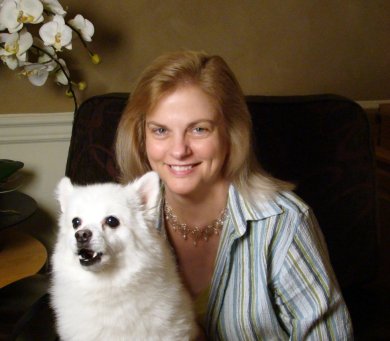
Lots of journals, my computer and my two small dogs, Frosti and Tommy. I also keep a hot cup of coffee or a cold drink nearby for those times when I need a little diversion.
Q9) If someone wants to start his own „journaling art“ in his own notebook / journal, what would you recommend to this person?
I would recommend to start small and to have fun with it. Recycle an old notebook you have lying around by drawing, writing or gluing pictures in it. You can use it like a visual diary or use words alone but do something crazy with it. Experiment with scraps of paper, fabric or old magazines, whatever you can glue down.
After you try a lot of different things, you will find some of your creations were more satisfying than others or you like certain processes better. Once you learn that, you can be more specific about how you will proceed with your next journal. Most important, don’t worry about the end product or about how many pages you have done. This will kill your creativity. Just let it flow and the process will tell the story in the end.
Q10) What are you doing beyond the „journaling“ part of your life?
I am the mother of a teenage daughter who keeps me very busy. She is my top priority. In addition to running the website www.journalingarts.com, I also have a presence on eBay under user ID beauty-of-art and I sell on Amazon.com. These things usually keep me busy 7 days a week, but when I have spare time, I like gardening, renovating my home and playing “catch the woobie” with my dogs.
Q11) What websites do you recommend to people interested in journals and notebooks?
There are quite a few sites that are great for notebook fanatics, but these are the first that come to mind.
BiffyBeans.com beautifully blends of art with reviews of journals, sketchbooks, fountain pens and ink. The reviews are thorough and thoughtful and give an artist’s perspective of journals and pens. This blog has the most extensive collection of reviews I have found and is a great resource for those who want to know more about journal brands.
If you are new to art journaling and are looking for ways to get started, ArtistJournals.com is brimming with ideas to help you start your first art journal. There you’ll find information on materials, color basics, collage, writing prompts and travel journaling.
If you are curious about what notebooks are on the market, BlackCover.com is a great resource for learning about different types of journals and there are some detailed reviews that will give you a better understanding of the notebooks. While this site hasn’t been updated in a while, it still has a lot of good information.
There are also a lot of social networks you can join where you can share ideas and work with others. There is a lot of beautiful journal art on these sites and the people are very friendly.
skineart.com: Art created in Moleskine notebooks.
mmcart.ning.com (Many Maniacs Creating Art): Lots of beautiful art journals.
moleskinerie.com: Everything you ever wanted to know about Moleskine notebooks.
moleskiners.com: Social network with Moleskine updates and art from around the web.
Q12) Personally, I got in contact with a lot of people only because I’m running notizbuchblog.de. What’s your experience with the notebook community?
The notebook community is comprised of a lot of creative people, many of whom are artists and/or writers. I have found them to be friendly and supportive. I met most of my notebook friends through my blog, Twitter or eBay and they are as crazy about notebooks as I am. I’ve enjoyed hearing about others experiences with their notebooks and pens. I have learned a lot from them and they have given me quite a few ideas for future reviews and articles. Being part of this notebook community gives me a sense of belonging and it is good to know I am not alone with this obsession.
Cynthia, thank you very much for this interesting interview! I wish you a lot of followers and a successful business with your shop.
Ähnliche Artikel in der gleichen Kategorie:

 ISBN: 978-379134369-3 (Partnerlink), © Buchcover: amazon.de